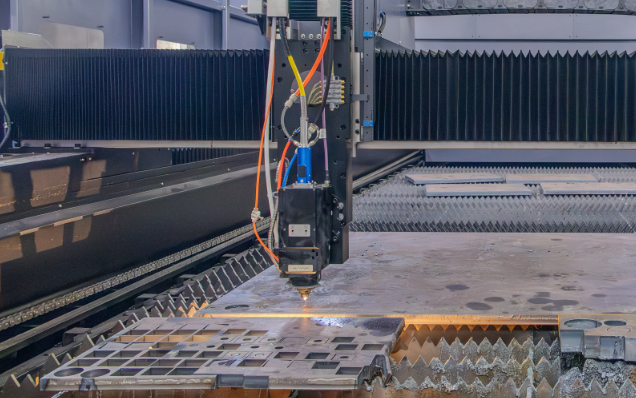
In today’s manufacturing environment, buying a machine is no longer just an operational decision — it is a capital allocation strategy. For factory owners and executive teams, the real question is not cutting speed or laser power, but the laser cutting machine ROI.
Understanding the true return of this investment requires looking far beyond the purchase price. A new system has the potential to reshape your entire profit structure — from material utilization and labor efficiency to order capacity expansion and cash flow acceleration.
This article explains how decision-makers should evaluate such an investment from a structural and financial perspective, rather than focusing solely on upfront cost.
Profit Does Not Come From Orders — It Comes From Structure
Many factories believe growth comes from increasing orders. In reality, profit growth comes from improving structure.
If two manufacturers process the same volume of steel but one earns 8% more margin, the difference is rarely sales ability. It is operational efficiency.
Laser cutting machine ROI is determined by four structural factors:
Material utilization
Labor allocation
Production speed and throughput
Quality stability and scrap rate
Let’s examine each from a decision-maker’s perspective.
1. Material Utilization: The Hidden Margin Multiplier
Steel is often the largest variable cost in fabrication.
A 3–5% improvement in material utilization may not sound dramatic, but at scale, it becomes substantial. For a mid-sized facility processing thousands of tons annually, even a small nesting efficiency gain can represent hundreds of thousands of dollars saved per year.
When calculating the return on a laser cutting machine investment, material savings should be quantified annually — not per sheet.
Ask yourself:
How much raw material do we process yearly?
What is our current scrap percentage?
What would a 3% improvement mean in actual dollars?
For many companies, improved nesting and precision alone can justify the investment within 12–18 months. These savings form a critical part of the overall return on investment.
2. Labor Optimization: Doing More With Fewer Bottlenecks
Labor costs continue rising globally, and skilled operators are increasingly difficult to recruit.
Modern laser systems — especially those integrated with automation modules — significantly reduce manual handling. Automated loading and unloading systems can transform a two- or three-operator process into a leaner workflow.
Laser cutting machine ROI must include:
Reduced operator headcount
Lower overtime costs
Fewer manual errors
Higher consistency across shifts
But the real value is not simply “saving one salary.” The real value is increasing output without expanding payroll proportionally.
When output increases while fixed labor remains stable, margins expand. That is how laser cutting machine ROI strengthens long-term competitiveness.
3. Throughput and Order Capacity: Revenue Acceleration
Faster cutting speeds and less downtime increase overall throughput. Higher throughput leads to:
Shorter lead times
Ability to accept more urgent orders
Higher customer satisfaction
Faster invoicing cycles
Cash flow speed is also important. When production cycles are shorter, billing cycles become faster, improving working capital performance.
Therefore, laser cutting machine ROI should also consider revenue-side factors, such as:
How many additional jobs can be processed each month
Average margin per job
Additional annual gross profit generated
In many cases, the extra revenue becomes a key driver of laser cutting machine ROI.
4. Quality Stability and Scrap Reduction
Rework and rejected parts silently erode profit.
Precision fiber laser systems provide cleaner edges, tighter tolerances, and more consistent performance. Reduced defect rates mean:
Lower material waste
Fewer secondary processes
Less welding correction
Improved downstream efficiency
When evaluating laser cutting machine ROI, include the financial value of scrap reduction and process stability. Small improvements compound quickly over thousands of parts.
How to Calculate Laser Cutting Machine ROI Properly
Too many companies oversimplify the equation.
The correct formula is:
Laser Cutting Machine ROI = Total Annual Added Profit ÷ Total Investment Cost
Where annual added profit includes:
Material savings
Labor optimization savings
Additional order capacity profit
Scrap and rework reduction
Maintenance efficiency improvements
A common misconception is that payback periods require three to five years. In well-structured operations, laser cutting machine ROI can often achieve full recovery within 12–24 months.
The key is comprehensive modeling — not emotional purchasing.
The Opportunity Cost of Delaying Investment
While executives carefully evaluate the expected return on a laser cutting system investment, many overlook opportunity cost.
What happens if modernization is delayed?
Competitors upgrade and offer shorter lead times.
Customers demand higher precision.
Pricing pressure intensifies.
Margins begin to compress.
In this context, the real risk is not investing — it is falling behind.
Any serious investment assessment should therefore consider not only direct financial returns, but also long-term competitive positioning.
Equipment as a Profit Strategy, Not a Cost Center
Successful manufacturers no longer see equipment as a cost item, but as a profit driver.
A well-selected high-performance laser cutting system can:
Improve material utilization
Stabilize production output
Unlock new market opportunities
Increase profit margins
Laser cutting machine ROI is about transformation, not just calculation. It reshapes how value is created within a factory.
For decision-makers, the focus should go beyond specifications. The real question belongs in the boardroom:
How will this investment affect profitability over the next five years?
When this is clearly defined through data and operational planning, laser cutting machine ROI becomes a strategic milestone rather than just a financial metric.